
Routed Drainer Grooves in Corian: Worth It or Not?
Drainer grooves routed into Corian beside the sink look neat and save a drying rack, but they collect limescale and need more cleaning, so weigh the pros and cons first.
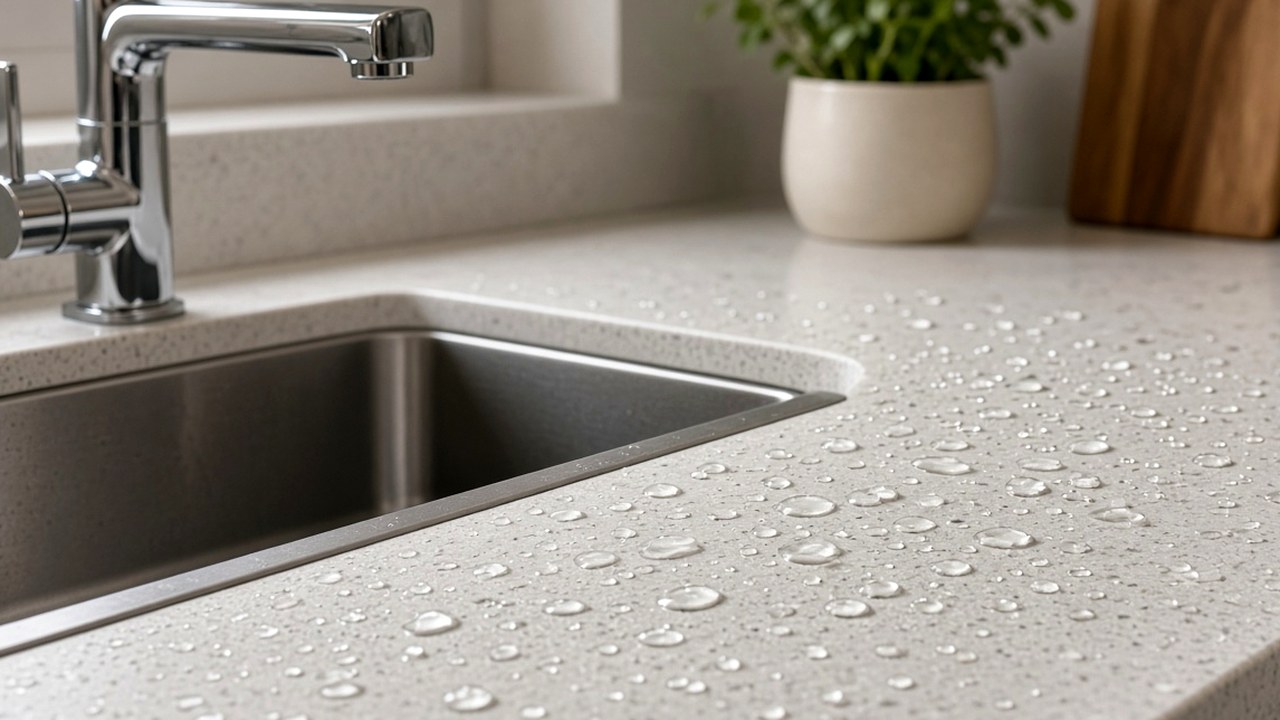
Drainer grooves routed into the worktop beside the sink are a popular Corian option. They let water from washed dishes run back into the sink and remove the need for a separate drainer. They also add cleaning work and can collect limescale. Corian Kitchen Worktops sets out the pros and cons so clients can decide before the template is taken.
How drainer grooves are made
Drainer grooves are routed into the Corian surface with a machine or hand router, creating shallow channels that slope towards the sink. Because Corian's colour runs through the material, the grooves are the same colour as the worktop. The grooves are sanded smooth and finished to match the surface.
Grooves are usually placed on one side of the sink, on the draining board area. The number, length and pattern of grooves can be customised.
- Grooves are routed into the Corian surface.
- They slope towards the sink to drain water.
- The number and pattern can be customised.
The advantages
Grooves keep the worktop tidy by directing water back into the sink. They remove the need for a plastic drainer or rack, which gives a cleaner look. With an integrated Corian sink, grooves create a continuous, seamless draining area.
For people who wash a lot of dishes by hand, grooves can be genuinely useful. Corian Kitchen Worktops explains integrated sinks in planning an integrated Corian sink as part of the run.
The disadvantages
Grooves collect water, and in hard-water areas that water leaves limescale in the channels. Grooves are harder to clean than a flat surface because a cloth does not reach easily into the channels. Food residue can also collect in them.
Grooves reduce the flat usable surface beside the sink. You cannot easily use that area for chopping or placing items that need a flat surface.
- Grooves collect limescale in hard-water areas.
- They are harder to clean than a flat surface.
- They reduce usable flat worktop space.
Choose a groove style
Groove styles range from a few simple lines to decorative patterns. Wider, shallower grooves are easier to clean than narrow, deep ones. Grooves that run all the way to the sink edge drain better than those that stop short.
Ask the fabricator to show you samples of different groove styles. Consider how you would clean each one.
Consider the alternatives
If you like the idea of a drainer but are unsure about grooves, consider a removable drainer tray that sits on the worktop, a rack that sits over the sink, or a sink with an integrated drainer. These can be removed and washed, and they leave the worktop flat.
Corian Kitchen Worktops covers white care in Glacier White Corian and the silicone habits that stain it.
Clean grooves regularly
If you choose grooves, clean them regularly with a soft brush and mild detergent. Dry them after use to prevent limescale. Occasionally, a limescale remover suitable for Corian can be used, following the care guide.
Corian Kitchen Worktops explains seams in inside the workshop joint that makes Corian look seamless.
Deciding whether you will really use them
Drainer grooves are most useful if you regularly hand-wash and leave dishes to drain on the worktop. If you use a dishwasher for almost everything, grooves may rarely be used and simply become something extra to clean. Think honestly about how you wash up before adding them.
Some households choose grooves on one side of the sink only, leaving the other side flat for food preparation.
- Useful for regular hand-washers.
- Less useful with heavy dishwasher use.
- Consider grooves on one side only.
Groove direction, length and fall
Grooves are usually routed with a slight fall towards the sink so water drains away. Their length and number affect how much draining space you gain. Longer grooves cover more area but take up more usable worktop space. Discuss groove layout with your fabricator, including how grooves end at the far edge.
Grooves with different sink types
Grooves work particularly well with integrated Corian sinks, where the water runs straight into the bowl with no rim. With undermount sinks, grooves stop at the cut-out edge. Inset sinks usually have their own drainer, making grooves unnecessary. The combination of an integrated bowl with grooves on one side is one of the neatest drainer details Corian allows.
- Ideal with integrated sinks.
- Stop at undermount cut-outs.
- Usually unnecessary with inset sinks.
Grooves and dark colours
In hard-water areas, grooves can collect limescale, which shows more on dark colours. Dry the grooves after use to reduce marks.
Adding grooves later
Grooves can sometimes be routed into an existing Corian worktop by a fabricator, but it is easier to decide at the design stage.
Groove profiles and hygiene
Grooves can be routed as narrow channels or wider, shallower flutes. Wider, rounded profiles are generally easier to clean than tight, narrow slots, because a cloth can reach the bottom of the groove. Ask to see a routed sample before deciding.
Questions about drainer grooves
Are drainer grooves hygienic?
They can be kept hygienic with regular cleaning, but they need more attention than a flat surface.
Can drainer grooves be added later?
It may be possible on an existing Corian worktop, but it is easier to plan them at fabrication.
Do drainer grooves work with an integrated sink?
Yes. They pair well with integrated Corian sinks for a seamless draining area.
Are drainer grooves worth it if I have a dishwasher?
Possibly not. They are most useful if you hand-wash regularly.
Can grooves be added to an existing Corian worktop?
Sometimes, by a fabricator, but it is simpler to decide at design stage.
Do grooves show limescale?
They can in hard-water areas, particularly on dark colours. Dry them after use.
Which groove profile is easiest to clean?
Wider, rounded flutes are usually easier to wipe than tight, narrow channels.
Do drainer grooves weaken the worktop?
Grooves are routed within the material's thickness to the fabricator's specification. Follow their guidance on groove depth and position.
Can grooves be added to both sides of the sink?
Yes, though many kitchens keep one side flat for food preparation and add grooves only on the draining side.
Next step with Corian Kitchen Worktops
Order a sample, then request a fitted quote or browse the worktop collection. The colour should be judged in your own daylight before anyone templates the run.